Friday, July 18, 2008

Myanmar experience

http://thestar.com.my/lifestyle/story.asp?file=/2008/7/19/lifeliving/1457412&sec=lifeliving

Count your blessings
By EUDORA LYNN
Cyclone-ravaged Myanmar changed our writer’s perception of life. She compares and contrasts life in Myanmar with Malaysia.

I take my life for granted. I do, I really do, and this is not meant to be another mouthpiece about how great it is to be Malaysian.
But we have been bitching recently about how hard our lives are without joyrides from Kuala Lumpur to Kajang in our 3,000cc four-wheel drives and European holidays that I thought I’d do a reality check.
It struck home when I visited Myanmar. Life in pre-cyclone Myanmar was tough by Malaysian standards; life post-cyclone is even harder. In Yangon, collapsed roofs and grates of government buildings remained unrepaired. Fences were smashed by trees. Pavements had holes as big as rain puddles.
“When are they going to be repaired?” I asked a Myanmarese friend.
“When the government has money,” she says, “which is not likely to be anytime soon.”

On electricity

I never realised how much we take electricity for granted. At home, whenever there is an outage, we’re on our phones immediately to Tenaga Nasional, screaming murder.
While visiting a shop in Yangon, the overhead fluorescent light suddenly dimmed. It sputtered, went dark completely, then came on again.
“Electrical outage?” I said knowingly.
“It’s our generator,” the shop owner informed me. “It’s been giving problems of late.”
“Why do you have generators?” I asked.
“Because in Myanmar, electricity is erratic. Not all areas have electricity and most of us have to pay for our own generators. There’s enough electricity to go round during the monsoon when the rivers swell and there is plenty of water to turn the hydroelectric turbines, but during the dry season, there isn’t enough power to go round. Even water is erratic. During the cyclone, there was no electricity and water for days. We had to depend on well water.”
“When looking for an apartment or house,” my friend chimed in, “we always try to seek a location where there’s water and electricity. You have to pay more for those apartments.”
The good thing about those apartments is that they are not costly by Malaysian standards. An average apartment in a good area costs around US$20,000-US$40,000 (RM64,600-RM129,200). But most people don’t earn that kind of money.
The government sector doles out a measly pay, as little as under US$3 (RM10) a month, although they don’t tax you. The private sector pays better, though you’d have to pay significant taxes.
There are no bank loans in Myanmar. Everything is paid by cash. To pay for an apartment, most sellers prefer to see money on the table — take it or leave it.

The kyat

The highest denomination of Myanmar currency is 1,000 Kyat, roughly equivalent to US$ 0.85 (RM3), though the rate fluctuates daily.
To get around the city, you’d have to have plenty of banknotes. The price of meals is roughly the equivalent of what you’d get in Malaysia — a bowl of curry noodles costs around US$1.20 (RM4), depending on its size. But if you contrast that to what the average Myanmar citizen gets, it’s a wonder anyone gets to eat out.
But most Myanmar people don’t go out much at all.
“It’s a habit from our curfew days,” said my friend. “You go to work and hurry home before it gets dark.”
Though homeless, this Myanmarese boy manages a smile. - AP
No expense, however, is spared for the temples — the ones I’ve seen in Yangon and Mandalay have Buddha statues and pagodas adorned with gold leaf.
You can buy four tiny wafer-thin ones for 1,500 kyat. Devotees stick these gold leaves onto statues. Collection boxes are rife everywhere, especially temples — Myanmar is a country of charity.
“And no wonder,” remarked an acquaintance, “if our government is not going to help us, who can we depend on but each other?”
But do not begrudge the temples and monks their relative wealth. The monks are everywhere, helping the needy. Foreigners are not allowed into the Irrawady Delta, the hardest cyclone-hit, but the Myanmarese showed me video clips. The monks are there, tending to the sick, swathing bandages over leg ulcers as big as saucers.
When my Myanmar friends asked me what I thought of Yangon and Mandalay, I told them truthfully both were beautiful cities, and the palaces and pagodas were splendid in the clean, relatively haze-free air. In fact, Yangon reminded me a lot of Penang and Ipoh.
The streets are broad, the houses colonial; there are plenty of umbrella trees providing much-needed shade. But that’s where similarities end. In Myanmar, the cars are sparser and there are few traffic jams. The roads and pavements are bumpy and broken; I have to watch where I tread every step of the way.
“There is no maintenance whatsoever,” my friend declared. “There simply isn’t enough money.”
Nor is a car easy to own. A normal sedan is costlier here than in Malaysia.
“If you want a Honda Accord, you’ll have to fork out US$70,000 (RM226,000) for it. On top of that, you have to pay US$80,000 (RM258,000) for a new car licence.”
That is why most citizens drive ancient, sputtering cars.
The concept of car maintenance is virtually unknown.
“When your car breaks down, then only will you repair it,” said my friend.

Survival

There are no motorcycles in Yangon. A top Junta general’s car got hit by a motorbike, the story goes, and he outlawed motorbikes in Yangon from then on. Public transport is extremely bad — buses are frequently late, dusty and dirty.
Tuk-tuks ply the road, ferrying passengers in the dust; sometimes as many as 20 people cling on to an open tuk-tuk meant for 10.
How is it, if one earns as little as US$3 a month, that one survives at all?
“Government servants take on extra jobs after hours,” my friend said. “It’s common to work two or even three jobs just to make enough to feed your family.”
Corruption in the government is rife; most do it just to survive. There is not enough government money to go around because of the economic sanctions placed on the Junta by lofty countries.
When there are sanctions, it is the average citizen who suffers.
I commented on how nice and polite most Myanmar workers were.
“They have to be,” my friend said. “They’re afraid of being sent back to Myanmar, so they’re always on their best behaviour and try to make themselves as ‘untroublesome’ as possible.”
In the end, the average Myanmar citizen still survives.
“We do not need much to be happy,” someone told me. “We are content with what we have and do not ask for much. And we are still happier than what most people in some so-called richer countries are.”

Friday, July 11, 2008

Galaxie review

My editor Nitha kindly sent this copy because as usual I missed it as I was not in the country.

GALAXIE MAY 15-31, 2008

For a brief moment when I got this book, I thought Dark City 2 was a collection of horror stories. So it was an unexpected treat to find it was anything but and so much more. This collection combines stories that are decidedly macabre (Till Death), suspenseful (Strong Chemistry), fiendish (Death Dealer) and most of all disturbing. The stories contain many surprises and twists. What's really cool about Dark City 2 is how familiar Malaysian scenes are ordinary things are creepily skewed. One peculiar story about a vengeful Hawker Man will ensure the next time you pass one i a dark alley, you'll make a hasty retreat. Reading Dark City 2 is like spinning a wheel of good fortune in that you're never sure what's coming next. You could be reading about a Good Nurse who goes beyond the call of duty for a modest extra income one minute and a photgrapher (open Shutter) who captures the unexpected the next. Even the easiest reads like All in a Day's Work and Dad have perplexing plot twists. So go ahead and take a walk on the dark side...if you dare. Geraldine Jeremiah

Saturday, June 28, 2008

Chick lit

Haven't blogged in a long time, I know - too much travelling, too tired. Doing this right now in Schilpol Airport while waiting for my connection to Spain. This article is published in the Star today and involved me interviewing Cecelia Ahern's publishers. Dunno if the sidebar showed up.

http://thestar.com.my/lifestyle/story.asp?file=/2008/6/29/lifebookshelf/21585761&sec=lifebookshelf

Happy lite lit

By EUDORA LYNN

In place of our monthly focus on literary titles, we turn our attention to what is, according to our writer, a sorely misunderstood genre: chick lit. Trashy and vapid? No, no, no, insists the passionate fan.


THERE are plenty of misconceptions about chick lit, such as that it’s “fluffy, trashy, shallow, mind-numbing, formulaic” and “something only a vapid woman can enjoy”. (Oh dear, that just about confirms my husband’s suspicions about me.)
Chick lit, for those of you who haven’t tuned into the world since 1992, is fiction written by women for women.
These books differ from other women’s books by almost always being humorous, appearing in bright, fluffy covers, usually featuring funny, fluffy caricatures, and being written, almost uniformly, in an extremely personal style, as though the reader is a gnat hovering around the female protagonist’s flat, eavesdropping on her conversations and life.
Chick lit is believed to have originated in the mid-1990s with Adele Lang’s Confession of a Sociopathic Social Climber. That kind of intimate, “I’m confiding in you, dear reader” sort of writing skyrocketed in popularity with Helen Fielding’s Bridget Jones’s Diary – and, with money to be made, everyone started jumping on board, of course.
Chick lit was also originally written for single working women in their 20s or 30s, but has since expanded into sub-genres that include mum lit (featuring the perils of young mums and mums-to-be), glamour lit (of glamorous social climbers and heiresses), mystery lit (think Desperate Housewives), wedding lit (self-explanatory) and fantasy lit (where something otherworldly happens to the protagonist, such as tripping into a different world – Cecelia Ahern’s There’s No Place Like Here – or different time zone – Sophie Kinsella’s Remember Me?)
There’s another burgeoning sub-genre called multi-cultural lit that can be further divided into Indian, Latina and other Asian. In these books, perky ethnic women try to carve out a life for themselves in a Western land, such as in books written by Nisha Minhas on Indian women living in Britain who are choked by cultural traditions and yet still manage to land spectacularly gorgeous Caucasian men. (Who are also very good in bed and initially have white girlfriends whom they will dump for said ethnic heroine.)
Phew, bet you never knew this was such a complicated genre, right?
What makes chick lit so enduringly popular is that there’s something for Everywoman to identify with. Chick lit heroines (tick characteristics you see in yourself):
1. Are usually single (even if you’re married now, you have once been single and kind of desperate, right?).
2. Are usually stuck in a job she doesn’t want to be in.
3. Are usually stuck with a boss she doesn’t want to be with.
4. Are usually fairly attractive but not stunningly so, and usually possessed of physical attributes she hates and totally wants to change (being overweight, snaggle haired, button nosed).
5. Have a gaggle of roommates/girlfriends/gay guy friends who are extremely supportive, promiscuous, and chatty.
Chick lit is also not exclusively romance, although a guy seems to trip into 99% of it since we women can’t seem to exist without men (I’m rolling my eyes, here).
Male love interests in chick lit are also attractive but the majority are also not panty-meltingly, heart-stoppingly so. If there are any superlatively handsome male characters, they usually turn out to be cads.
Chick lit protagonists also have a lot of other stuff going on in their lives, such as juggling careers, dealing with bad habits like being a chocoholic or a shopaholic, balancing their bankbooks, cooking bad food, and basically going through the exhaustive process of finding themselves. It’s Sex and the City, only with a lot less sex.
In other words, the writers of chick lit seem to be saying – to me, anyway – “This is you. You can totally see yourself in this. We are writing you for you.” (And also to make a lot of money.)
Chick lit stories end well, usually with the heroine getting the job of her dreams and landing her true love, a fact that also contributes to the genre’s appeal.
At the end of the day, when you pick up chick lit, you want a happy, humorous story you can laugh over and see yourself in (with chagrin), you want to find solutions to trials and tribulations you yourself have been through, and you want to know that if a fictitious someone else can have a happy ending, you can have it too.
And that’s all we really want in our lives, happy endings.


And these are a few Q and As from Penguin which I did an email interview.

1. What do you look for in the writing when you decide to publish something in the genre of chick lit?

We look for lots of things but most importantly it is making a connection in a fun way with the reader using the themes of love romance
and fidelity in relationships. The tone should be light and highly readable and a touch of devil may care mischief always goes down a treat.


2. On average, how much does a chick lit title sell?

Our bestselling authors sell over 100 000 copies


3. What is your biggest chick lit title? How many copies has it sold?

The answer is SUDDENLY SINGLE which has done 320k since 1999. Best since then is YOURS FAITHFULLY at 272k. Jill Mansell is usually at about the 200k level.

Monday, April 28, 2008

Low-lit


I'm still extremely low-lit, I've discovered. It took me ages to finish this book with the deceptive chick/guy-lit cover, which turned out to actually be lit in disguise.


Sunday, March 16, 2008

Oh Malaysia, I love you

That's why when I voted in my old school, Sri Aman, I went in with a vision of you in my mind. I went in visualising:

- a Malaysia where no corruption exists, where my hard-earned money going into considerable taxes would fuel a world where open tenders are declared, the best man gets the contract based on merit and funds are well spent on education, health and good transportation for the masses

- a Malaysia where there will be a minimum wage so that the hardcore poor will forever be eradicated

- a Malaysia where scholarships and promotions are awarded on how well you do, not who you know

- a Malaysia where the colour of your skin is no longer of consequence

- a Malaysia which can compete in the world economy, where investors are not given the runaround of endless red tape

- a Malaysia that is safe, where we can go about our business without physical threat to our safety, where the police exists to serve us, the people, and are given a minimum wage to exist so they will no longer feel the need to take bribes

- a Malaysia that is tolerant to newcomers from other Asian and African countries, who might one day be Malaysians too, where citizens do not feel the need to treat other people from less fortunate nations as though they are pariahs

Malaysia, I voted for you.

Monday, March 03, 2008

The Misdirect

Ever read a story or watched a movie when the plot threw you a curveball suddenly that had you gasping, "Wow! I didn't see that coming!"? You are of course bowled over by the audaciousness of the writers: "Wow, how did he/she come up with something like that? I wish I can do it too."

Actually, you can.

The plots that twist and turn and throw you curveballs and hardballs and anything else that would have you grasping balls (pardon the language) have a common ploy -- the Misdirect. You've probably used it yourself, only you didn't realise it was called a Misdirect; the same way you wield the English language without realising you're using pronouns and verbs and adjectives, all in the same sentence. (The fact I'm perpetually using all these still continues to leave me speechless.)

A Misdirect can be summed up like this:
1. Come up with your plot twist/ending first.
2. Now lead your reader away from it by leading them down another direction, so when it hits them, they'll say, "Wow, I didn't see that coming!"

Even Booker Prize winners do it too, which is why Margaret Atwood's 'The Blind Assassin' is so satisfying. Basically, what she did was: (Warning, I'm going to spoil 'The Blind Assassin' here)

1. The big knockout twist at the end was that the 'I' character was the one who wrote the science-fiction stories and had the affair with her sister's lover

2. So Margaret starts out at the very beginning of the book, even before the first chapter, to lead the reader down the wrong path. The 'I' character is introduced receiving news of her sister's sudden death. She goes to retrieve her sister's artifacts, finding some old exercise books.

3. The very next chapter has some newspaper clippings on how her sister's posthumous science-fiction book is published, leading to worldwide fame and recognition. Therefore, the reader immediately 'assumes' that what the 'I' character found was her sister's manuscript in the old exercise books.

4. The rest of the story is about their lives, interspersed with excerpts from the science-fiction book, to help the reader understand why the 'I' character did what she did.


In short stories with a twist, 'Misdirect' is also a trick employed very often. I've been guilty of doing it myself over and over again before I even understood the term 'Misdirect'. But if you want to employ a Misdirect, you have to map out your plot point twist/ending first. How can you lead the reader down a wrong path if you yourself don't know which path you're heading, right?

Next: Doublespeak and Doublethink


Tuesday, February 05, 2008

Interview with Chua Kok Yee!

Here's from author Chua Kok Yee of 'News from Home' fame. He also write 'The Penalty' for Dark City 2, which has been highly acclaimed.


1. What inspired you to write?

I have strong inclination towards creative pursues like drawing and writing since I was young. In my younger days, I spent more time drawing and doodling than writing. Actually, I didn’t start writing with an intention to produce any stories in word form. It was supposed to be brief plot and synopsis for my comic stories. It was during that process I accidentally discovered the joy of writing, and I have been addicted to it since. Besides, writing is a very therapeutic activity against the stress and pressure of corporate life.

2. Without giving too much away, how did you get the idea for your story, 'The Penalty'?

The idea came from the famous Michael Chong of the MCA Public Complaint Bureau. Not directly from the man, of course, but from those numerous news reports on loan sharks and their victims. It made me wonder why there are still so many people out there that resorted to Ah Longs despite the repeated warnings from the authority. I was also wondering about the reaction of the ‘ah longs’ to these reports. In a way they are the ‘victims’ too because the debt was a consensual business agreement between two parties. Yet, the borrowers went crying wolf when they defaulted on the loans! That was how the seed of the story was planted inside my head.

3. You have a book out, 'News from Home'. Can you tell us more about it?

News From Home is an anthology of short stories from three new authors; Shih-Li Kow, Rumaizah Abu Bakar and me. Each writer contributed ten stories in this collection, and the book is the first book to carry the Silverfishbooks’ ‘Malaysian Literature in English’ sticker. The thirty stories of various genres would introduce the readers to each author’s own distinctive voice and style. It’s available on all major bookstores or you can get it online via www.silverfishbooks.com

4. Which authors inspire you? Which genre do you prefer?

Stephen King, Haruki Murakami and Neil Gaiman. I like stories with a touch of supernatural or fantasy.

5. Do you have any advice for budding authors?

First advice is to read a lot. The second advice is to cut down the talking about writing, and spend more time actually doing it. Lastly, do have thick face and open mind to accept criticisms.

Sunday, January 27, 2008

MPH LitBlogger's Club yesterday


So finally it was Tunku Halim and me on the podium. There were about 25 - 30 people there, quite a full house and standing room only (with the usual empty chairs in front and in the inaccessible middle) . . . thanks to TH who really pulled them in, yay! (Okay, I must admit I arm-twisted at least 8 people to be there, including my colleagues.)

MPH also took the opportunity to launch TH's novella, Juriah's Song, which really had a great faux book gimmick to go with it, along with string cutting and all.

For my session, I dragged Lydia Teh, TH and Chua Kok Yee up with me because I was afraid of boring everybody if I were go by myself. We spoke about writing and rewriting and what a horrible taskmaster I am for making everybody write and rewrite.

RTM2 was there also for 'Hello on 2', which is I presume a morning show. So they interviewed each of us individually - TH, me, Lydia and Kok Yee - and I was so glad I wore something decent to appear on TV and that I didn't go in T-shirt and slippers. I don't actually remember what I said because I had to talk non-stop for 10 minutes, but I remember holding up my 2 books and shaking them ever so often, and even filming a little teaser in which I went, "Hi, I'm Xeus, and you're watching 'Hello on 2'. "

Then of course we all went for lunch and gabbed about everything and everybody. I realise Lydia and TH are so much more prolific and ambitious than I am - they have so many books and projects lined up, and when they asked me what I had in store, I had to admit I had only 2 :(

Ah well, it was great to meet up with everyone again. (And yes, Kenny too although he was late!) Thanks Grace for being there in spirit although you couldn't physically be present, and I wrote you a lovely message in your personalised copy of DC2. It was great to see Lyrical Lemongrass and Daphne there too and I thanked her personally for plugging DC2 in Star, and she had news for me - Michael Cheang is reviewing DC2 for Star. (And I went 'Yikes! He's tough!')

Okay, what do you think of this title for a humorous anecdote collection type of book: 'Don't stand too close to a naked Malaysian'? I tried it on everybody there and they hated it!

Wednesday, January 23, 2008

Borneo Post review

Courtesy of Georgette...


"The first Dark City was a compilation of short stories by an author who goes by the pseudonym Xeus. She returns with the sequel, together with 14 other writers. Some are names you've heard before if you're paying attention to the Malaysian writing or blogging scene, while others will come as surprises.

Ahmad Azrai's "Death Dealer" stands out for its unusual setting. As it opens in the era of Sultan Muzaffar Shah, a boy strikes a deal with the Angel of Death. I have to admit that this is the kind of story I've envisioned to death (heh) myself, which is why it attracted me. I only wish that there was more of a middle to go with that beginning and ending.

Lydia Teh, whose last book was the very funny "Honk! If you're Malaysian", told me how she pulled "Hin's Moment of Truth" out of a dusty archive somewhere and reworked it for DC2. Probably still her only fiction piece to date, her story is about a gambler who is about to get lucky in a nasty twist kind of way.

Xeus has this knack of making me burst out laughing with the conclusions of her stories and "Signature Spa" is no exception. (It only shows what a sick individual I am.) Spas are at every corner now, fighting for customers and the self-centred protagonist of this story finds herself a deal too good to be true.

Jennifer Tai has a story about a banker's encounter with a mother and her son; Noor Bebe brings us a half-touching and half-creepy tale of a woman looking for her missing husband in "Trapped"; John Ling provides a knife-twist of revenge in "Zero Sum"; and Chua KokYee's "The Penalty" brings us into the world of football gambling.

With 17 stories, there is something for everyone looking for a taste of the macabre and plenty for anyone who enjoys a wicked sense of humour. While most of the stories appear to be set in metropolitan KL, there are a handful of tales that take place outside it... like the one about the photojournalist who works in Kuching.

Dark City 2 have not yet been sighted in local book stores. "

Saturday, January 19, 2008

NST snippet and article on local books


I'm so glad that NST decided to run this feature on local books yesterday - a very positive one. I wouldn't have known it if Yvonne hadn't texted me when I'm overseas and told me about it. Thanks Yvonne!


Chuah Kok Yee and Tunku Halim are also featured.


By : SU AZIZ 2008/01/18


Shame on you if you do not read our local authors, especially when SU AZIZ shows you the best picks.


THE resolution to read more local authors is not a recent one. In fact, it is one that has been festering at the back of my mind for years.
At the beginning of this year, I was resolute on keeping it. Hence the myriad of books below produced by our own writing talent from various backgrounds, age groups and genres.
I am most certain you will be able to pick one that will appeal to you. Well, here goes!

Short stories and compilations:
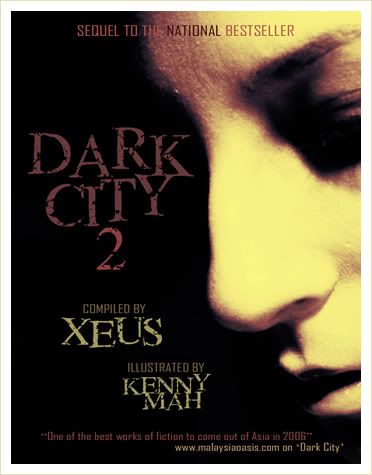
DARK CITY 2Compiled by Xeus
A sequel to the bestseller published a couple of years ago, this one consists of 17 thrilling short stories by 15 authors.
Some are first-time published authors while others are more known and experienced writers.
The likes of Lydia Teh, Tunku Halim and Xeus fall into the latter category. A perplexing page-turning read for those dark, stormy and rainy nights.
Most of all, it is a terrific book for bite-sized samples of styles from our local authors.
This one is published by Midnight Press and available in major bookstores.
Variant 1: For a more relaxing bite-sized samples of local authors, Silverfish Books has just published News From Home, featuring 30 short stories from Chua Kok Yee, Shih-Li Kow and Rumaizah Abu Bakar.
Not quite local but close to home. Read Wena Poon’s collection of short stories on displaced Singaporeans living abroad in Lions in Winter.
Variant 2: For a touch of poetry dedicated to, as the author wrote, “love”, is Diver & Other Poems by Alina Rastam.
This compilation of 20 poetries is published by Cricket Communications Sdn Bhd.
Variant 3: Or grab a copy of Young Women Speak Out, a compilation of essays and poems by the participants of AWAM’s (All Women’s Action Society) Writers for Women’s Rights Programme.
An interesting sample of works by our young women highlighting their issues and concerns.

Latest works by our experienced authors:

GLIMPSESBy Adibah Amin
On a brighter note, this one holds colourful accounts of Malaysian habits, written in a style that is vintage in Adibah Amin.
A name synonymous with good English, Adibah is no stranger in the literary world.
In this one, her sense of humour and power of observation are both lucid and tangible.
A favourite? Chew on this, “How could a local product be any good? He must have been sent overseas for ‘manufacturing’, to return to triumph as an ‘imported’ item”. Published by MPH Publishing, this one’s available in all major bookstores.

JURIAH’S SONGBy Tunku Halim
This one entertained me as much as the story itself. The author, in the introduction page, admitted that it was inspired by two incidents.
One was when band members that had been playing at a hotel lounge joined him for a drink.
The other was an unsettling tale of a friend.
Known for his thrilling dark tales of suspense, this is Tunku Halim’s ninth supernatural thriller. It tells of a rock star who is pursued by a female demon.
Published by MHP Publishing, it is available in all major booktores.

Self-help books right here:

HOW TO TALK YOUR WAY TO THE TOPBy Michelle Lian
The title of the book is self explanatory. It basically helps you to learn how to better your communication skill, get others to listen and acquire the gift of the gab.
The question is, who is Michelle Lian? Is she an authority to preach on this matter?
For starters, she authored TEAMWORK! Rebuilding Winning Team Spirit and has held seminars or workshops that help people “discover simple truths to better their lives and careers with greater success”.
Besides, her books have been translated into other languages. The English version is readily available in MPH bookstores or online.
These final three books, which are easily available in either MPH or major bookstores, are designed to inspire and better the environment in which you have chosen to live in.
The first one is where you can “acquire secrets of formula feng shui” to “get the kind of results you have always wanted” in finance, health and even better exam grades!
It can be no other than a book by Lillian Too, Flying Star Feng Shui Made Easy.
I can neither make head nor tail of it but a colleague has already snatched the book off my desk, even as I write this.
The second is a result of an enlightenment during the author’s battle with fourth stage terminal cancer relapse after a 12-year remission.
Shery S.L. Lim’s There Is Hope carries all her faith in the big guy with “comforting and encouraging words” for those going through tough times in their lives.
A touch of solidarity is always welcome, no? It sure makes the world a less lonely place.

Lastly, carrying on the theme of solidarity, this slim, pink book, published by MPH Publishing for PRIDE Foundation, highlights personal accounts of cancer patients.
Take Pride In Your Life! also provides with coping tips for cancer patients as well as for those around them to “better manage the illness”.
Included is an audio CD featuring motivational speakers such as Datuk Dr Fadzilah Kamsah, Rene’e Aziz Ahmad and other experts.

Friday, January 11, 2008

The word 'No'

I wrote this in The Star today:

The word 'No'

For her second collection of short stories, Dark City 2, writer-turned-editor XEUS learns what it means to say ‘No’ and to give heartbreaking feedback to writers.


NO’’ is such an ugly word, compressing rejection, indifference and the fragmentation of dreams into so many petals of dandelion puff.
Goodness knows how many times I’ve been at the receiving end of it, only, I’ve heard it in other forms: “I’m sorry, but there’s another candidate more suitable for the job.” (Translation: “Your interview sucked big-time and the only way we’d want you working for our company is hauling trash cans.”)
“We love your writing, but we’re not currently publishing ?” (Translation: “We lied. We hate everything about your writing.”)
“You’re a nice girl and all, but I’m not ready for a relationship . . .” (Translation: “I wouldn’t go out with you even if my rich parents bribed me with a Bandar Utama semi-D and you wore a paper bag over your head.”)
I used to think “No” meant all that until I found myself on the other end of “No” – the giving end.
Last December, I ran a nationwide contest in The Star calling for submissions to a sequel for my first collection of short stories with a twist, Dark City, which would be imaginatively titled, after an exhaustive nationwide title search, Dark City 2.

Writing is like Math, kind of
I received over 60 submissions, some of them multiple ones, from not only Malaysia, but all over the world.
Ah, the wonders of the worldwide web and interactive blogosphere. Then I started to read them, and I went: “Hmmmmm . . .”
No, don’t get me wrong. There are plenty of people who can write, and do it very well. There are also plenty of people who can tell a story, and tell it very well. But unfortunately most of the time, the two groups don’t mingle. It’s just as my math teacher used to envision it:
“Kawasan tindihan dua subset ini sangat nipis.” (Translation: “When the two groups collide, you get thunder and lightning and J. K. Rowling.”)
A lot of the time, I’ve discovered that those would-be writers with great grammar and wordplay don’t often tell a story well. And those who tell a story well don’t often have great grammar.
Remembering all those times I heard “No,” I thought long and hard about how I was going to couch the dreaded word.
I mean, I wanted my “No” to be spiritually uplifting and enriching. I wanted my “No” to be the pivotal turn in some writer’s life. I wanted my “No,’’ to go down in EQ 101 books as “Now, that’s the way to say ‘No!’ “ Oh boy, who was I kidding? So I chickened out.

The editor who is a chicken
I didn’t say “No.” I said, via the anonymity of e-mail, “Dear _______, I think you are a very good writer and you have the makings of a wonderful storyteller. But the problem with your story is blah, blah, blah, as I’ve outlined very carefully in Microsoft Word red. But not to fear, it can be fixed! Would you mind rewriting to include the comments on blah, blah, blah?”
Most of the time, the writers do acknowledge this by rewriting (some multiple times) and e-mailing back: “Thank you so much for taking the effort to go through my story with a fine-toothed comb. I’m very grateful for this.” And of course, I never hear from some again. (Translation: “If you don’t like my work, fine, I’ll take it elsewhere – YOU SUCK!”)
I must admit to turning to my writer friends for a lot of the stories in Dark City 2. After two months. I was getting desperate because I didn’t have enough stories in the can. I shot off a note to my friend, Malaysia’s own Stephen King, Tunku Halim, and begged, “Help me and I will give you my firstborn child!”
Which of course he promptly did by contributing one story, Hawker Man, about the perils of looking soybean sellers too long in the eye. I then shot off a note to another famous friend, Lydia Teh (Honk! If you are a Malaysian), who refused all offers of my firstborn children because she already has four.
Lydia wrote this in her blog: “I pulled out Hin’s Moment of Truth and e-mailed it to Xeus. Hey, I like the story, she said, but you need to expand it. I reworked the story according to her suggestions.”
So you see, even famous published writers rewrite and rewrite! But among the first-time writers, I found a lot of gems.
Former Star2 assistant editor, Lou Joon Yee, got wonderful reviews for her Till Death which she wrote and rewrote. It's a story about a husband and wife who fantasise about killing, and re-killing, each other (Don’t we all, at some time?)
So the moral of the story is that a “No”, when couched in the emphatic package of caring feedback to help a fellow writer, can be turned into a “Yes.” That is, with multiple rewrites.


Xeus is the author of Dark City and the conceptual editor of the newly released Dark City 2, an anthology of tales with a twist which features 14 authors who are used to rewriting multiple times. For more stories on these agonising rewrites, you can visit her blog at http://www.darkcity-xeus.blogspot.com/

Saturday, December 22, 2007

Jumping the shark


I was talking to Sharon the other day about the plot term 'jumping the shark', and I was telling her what I understood it meant: that you keep coming up with twists just for the sake of it (keeping your readers/viewers interested).

Turns out I wasn't far off.

This is a very funny explanation about plot devices that can be termed 'jumping the shark'. Are you guilty of any of them? (usually happens in serialised stories which have gone on and on for some time.) Do you think Harry Potter has jumped the shark at any moment? Personally, I thought it went downhill after Goblet of Fire.

"The term jumping the shark alludes to a scene in the TV series 'Happy Days' when the popular character Arthur "Fonzie" Fonzarelli jumps over a shark while water skiing. The scene was so preposterous that many believed it to be an ill-conceived attempt at reviving the declining ratings of the flagging show.
Since then, the phrase has become a colloquialism used by critics and fans to denote the point at which the characters or plot of a TV series veer into a ridiculous, out-of-the-ordinary storyline. Such a show is typically deemed to have passed its peak. Once a show has "jumped the shark" fans sense a noticeable decline in quality or feel the show has undergone too many changes to retain its original charm.

1. Same Character, Different Actor
When a new actor is hired to fill the same role of a departed one. However, this category has also been applied to new actors hired to play the role of a new character that is essentially the same as the original.

Notes: Ha ha, this happened in 'Dynasty', 'Dallas' and practically every long-running soap. Worse yet, I remember the one in 'Dynasty' was explained by his having plastic surgery!

2. One of the characters gives birth.
Notes: 'Friends' anyone? Is there anyone who hasn't given birth on 'Friends'? (some multiple times). 'Mad About You'.

3. Death
A character's departure is explained with his/her death. This can be due either to the actor/actress who filled the role leaving the show, or a real-life death.

Notes: Hah! Prison Break, guilty as hell. So is every soap opera. And 'House' has fired all his medical staff.

4. Puberty
Children who are members of the cast enter adolescence and/or approach adulthood.
Notes: Cosby Show. I think in Harry Potter's case, adolescence was a good thing.

5. Singing
Non-musical members of the cast (or those never thought previously to have performing talent) sing as part of a musical number during an episode.

Notes: Buffy the Vampire Slayer, the musical episode! Xena Warrior Princess.

6. Two main characters are married.

Notes: Friends again! As far as I'm concerned, Friends jumped the shark after Season 3.

7. Two main characters have sex, particularly if their sexual tension was deemed part of the show's appeal.

Notes: Every series that does this goes downhill after that. Think 'Remington Steele', 'Moonlighting'. 'Cheers'. Thank goodness no one in the 'X-Files' ever had sex. (with each other, I mean). Can people on 'CSI' be considered having 'sex'?

8. Moving
The main characters move from their familiar surroundings, usually to new surrounding some distance away.

9. New kid in town
When a new character (often, a young child) is added to the cast, in response to former child actors who have entered adolescence or adulthood, and/or to revive falling ratings.

Notes: Cosby show! Then again, the 'Desperate Housewives' always have new neighbours. And 'Heroes' keeps on adding people I can never keep track of.

Tuesday, December 18, 2007

Want to go to a Creative Writing Workshop?

Guys, Tunku Halim is organising a creative writing workshop! This is gonna be exciting! Bring your kids.

Event: Creative Writing Workshop with Tunku Halim
Venue: The Booker Room at MPH Megastore 1 Utama, Petaling Jaya
Date: 20 January 2008 (Sunday)
Time: 11:00a.m.-3:00p.m.


Ever wanted to write a short story, a longer tale or perhaps even a novel? Tunku Halim, novelist, short-story writer and author of such books as A Children's History of Malaysia, 44 Cemetery Road , Gravedigger's Kiss and the soon-to-be-released Juriah's Song will show you how. By using an array of tools such as setting, dialogue, plot, description, economy of words and creative flow, you'll not only get started with full confidence but you'll also see your work flourish off the page!If you're interested and between the ages 13 and 18 years old, you can pre-register at MPH Megastore 1 Utama's customer service in early January 2008.

Registration fee is RM20 for MPH members and RM30 for non-MPH members with lunch provided.
Course structure:
11:00a.m. – 12:30p.m.: Point of view, Plot, Character, Dialogue
12:30p.m. – 1:15p.m.: Lunch1:15p.m. – 2:30p.m.: Creative Flow, Description, Economy of Words, Setting, Rewriting, Editing2:30p.m. – 3:00p.m.: Discussion

Participants will stand a chance to win an autographed copy of Tunku Halim's Gravedigger's Kiss courtesy of MPH Distributors!

Sunday, December 16, 2007

Another review by a famous writer!

By none other than Tunku Halim! Malaysia's very own Stephen King! Hope you don't mind if I link this because I need to file it as a keepsake.

I truly thought Kenny's cover was stunning but I was a bit disappointed by the production quality of the colours. And TH, I wish all bios were like yours :)

I did have fun writing 'Strong Chemistry' but it was a very difficult story to write as it involved so much research. Had to pore through US chemistry websites to see if my concoctions would work. Then actually set up a little experiment involving my car speaker to see if what my husband postulated will actually work in real life. I remember writing most of it in a taxi back from KLIA.

'Signature Spa' was a lot easier to write because, as Argus will attest, I know everything there is to know about spas, ha ha. And it came up because Argus and I once visited a spa in Langkawi where they literally wrapped us up in wild rice and coconut leaves; hence a 'nasi lemak' spa. 'Signature Spa' is actually meant to be humorous in a dark, tongue-in-cheek way (don't know if that came across!)

Funny how we get our story ideas.


Peering into Dark City 2

A couple of weeks back I was delighted to find several copies of Dark City 2 waiting for me. Once the brown paper was ripped away I beheld the stunning cover by Kenny Mah. (Why on earth I haven’t used him on my recent books still confounds me!)

I read the Editor’s Note, flipped through the stories and then the bio of each writer. The first thing that struck me was that my bio just seemed too long. Next time, I’ll need to be more succinct!
The 4th story was my contribution - “Hawker Man”. I wrote it about 12 months ago when Xeus approached me for a tale. I was grateful for the opportunity as I hadn’t written any fiction (well hadn’t finished any fiction, to be more accurate) for a few years. Although she did ask for a twist at the end of the tale, I told her I wasn’t a twisty kind of guy. So you’ll find that “Hawker Man” hasn’t got much of a twist. But still, I’m pretty proud of it . . . especially the hawker man swinging his white cloth in the air, grinning, as his slippers slap the floor toward you!

I then turned to the first story “Strong Chemistry” by Xeus. Three pages into the story I went “Wow! This is bloody good!”. I have to admit I said it with a touch of envy. This woman can write lah. This is Poe’s “The Pit and the Pendulum” Malaysian-style!

I couldn’t resist reading Xeus’s second tale – “Signature Spa”. A story after my own heart, indeed it was. I was set adrift by the scents of essential oils and I could almost feel the soothing treatments as the oils permeated my skin. I could guess, with trembling delight, at what was going to happen – it was like watching a car crash in slow motion. But the gourmet twist was a surprise. For me, it’s “Paradise Revisited” in 2008!

My congrats to Xeus on her new book, not only as author but editor. Congratulations as well to all those whose stories were published. For those who are published for the first time, it is a very memorable occasion, like no other.

Well done, you guys!

Friday, December 14, 2007

Dark Tales

This appeared in Star today. Thanks, Argus, for pointing it out! And thanks Daphne, for highlighting this book even though I know it's so NOT your thing :)

A funny thing happened the other day when I met Daphne for the first time. We were at Delish after a LitBlogger's meet and she came up to me and said, "I don't believe I've met you. I'm Daphne." I said, "I'm _____". And she was stymied: "YOU are _______? I've been editing you for years! You write for Star and Galaxie, don't you?"
Thank goodness she was gracious enough not to say "By the way, you were horrible to edit and I used to get nightmares whenever I get your copy."
See what a small world this is?


Compiled by DAPHNE LEE

Dark City 2 Compiled by: Xeus Publisher: Midnight Press, 341 pages

DARK City’s second instalment compiles the work of 15 authors, including Tunku Halim, Lydia Teh, Ted Mahsun, Georgette Tan and Xeus, who was solely responsible for the first Dark City collection. Comprising 17 short stories, this Malaysian publication aims to send shivers up your spine, keep you guessing and leave you begging for more. Who knows, there may even be a Dark City 3!

Tuesday, December 11, 2007

Interview by Kenny Mah

I'm just putting this here so I can have a permanent link just in case Kenny decides to delete it one day! I just love those photo negative montages Kenny has of his drawings in DC2.

Interview

Finally, after months of waiting… the book is out! I recently interviewed the mastermind behind it all — Xeus. And yes, as a surprise to readers who thought I only did the cover, I did the inside illustrations too! :D

Dark City 2 cover

KENNY: What was your original inspiration for Dark City?

XEUS: Actually, I was interviewing 4 women authors for ‘Her World’. And then it hit me, hey, I want to write a book too!

Dark City is largely inspired by ‘Sin City’, about all the things that can go terribly wrong with city life. KL is an intensely interesting city with so many layers anyway, you can virtually find any situation in it.

Why the change of format for its sequel (i.e. an anthology of different writers)?

Truth? I couldn’t finish writing it myself! I’m involved in writing too many simultaneous books and projects, on top of having a fulltime job. So I thought - why not get other people to write in as well? Give everyone a platform, especially first time writers. It would be an interesting experience to edit conceptually.

And I’m glad I did. I mean, we now have such gems like Lou Joon Yee’s critically acclaimed ‘Till Death’. We have Chua Kok Yee who is such a great storyteller with a sense of pacing and timing. We have Ahmad Azrai who is so lyrical, and we have Bissme, who specialises in the shocking twist. And on top of that, Lydia Teh got to publish her first fiction story, John Ling got to explore the ‘I’ format and Tunku Halim gave me a story that would be the first new one to go into his book ‘Gravedigger’s Kiss’.

And we have Kenny Mah designing the cover!

Fortunes are told...

What would you say would be your most identifiable style (characterisation, genre, plotting, etc.)?

Plotting.

I love plotting. That’s why I write. I have little notes all over to tell me where the plot is heading. Sometimes, I’m so impatient to get to my plot point or big reveal that I actually dread having to write so much to get there! I think I’d do better at screenwriting if that were the case, only I suck at dialogue.

Even when I read books or watch movies/TV, I go essentially for the plot.

However, many critics have pointed out that my most identifiable feature is ‘detailed writing’. And it’s funny, because when I used to write romantic fiction on the net, the feedback was my most identifiable feature is ‘characterisation’. (Hey, it’s romance, there’s not much plot!)

I would say I’m really into characters as well, except in a short story, it’s very difficult to delve fully into character as you won’t have enough pages to go too deep into anything that does not service your plot. I’m not good enough a character writer to fully do that in a short story.

But in a novel, you are fully expected to delve completely into your characters. And you’ll have no excuse because you’ll have plenty of pages for that.

Your stories always comes with a twist in the tale. How do you come up with them?

By misdirecting the reader in one direction, only to serve up the twist in the other direction. It’s actually a classic misdirect, with all the characters doing doublespeak and doublethink (which means they will not say or think anything that will give the ending away, and yet, what they say and think is perfectly in line with the situation).

If this sounds like gobbledygook, I did promise someone I will blog more about it someday. It actually requires quite a detailed explanation!

Lust without caution...

What are your future plans? Another sequel? Or some other project?

I’m currently in my 3rd write of my children’s book, which is part of a series. This is the one I’m really hoping will be picked up by UK/US. That’s why I’ve taken over 1 1/2 years for it, because I want to make it as good as possible. No, I’m embarrassed to say (hangs head in shame) the characters in it are not Malaysian. (But they are multiracial! That’s gotta count for something!)

If it doesn’t get picked up by UK/US, it’s okay. I have tried. But this is really what I want to do - be a mainstream writer for the world market. And I want to write fulltime.

At the same time, I’m halfway through a book for MPH. It’s non-fiction. I submit one anecdote/chapter a week. This book will probably be finished next April. Beware writers, you might be shown an advanced copy and be asked for quotes!


Monday, December 03, 2007

Interview with Kenny Mah!

And now we have an interview with the illustrator himself, the illustrious Kenny Mah! Ta da (drumroll)

1. How did you start out being an illustrator?

Almost by accident, actually. I've always loved drawing, painting, design, anything to do with art, really. There's a long-running story in my family that I started both reading and drawing at the age of two, a sign of precociousness that I hope I have outgrown.

Then there were the amateur comic strips I drew as a teenager that were never shown to anyone else... but the correct answer to your question, if there is one, I suppose, would be when I started blogging and despairing of suitable graphics to use (this was in 2001, when blogging was still a new thing), decided to dabble with design myself.

And a few years later, here I am. I'm still an amateur/freelancer, but the passion does feed the heart, if not the belly...


==============================

2. What gave you the inspiration for Dark City 2's cover?

Basically, I wanted a cover that moved away from the garish, long-haired "pontianak" look of so many local horror/suspense/mystery novels. I wanted something more sensual and classy-looking. To this end, I decided upon the concept of a sad, contemplative lady with secrets to hide.

Then I did three versions of the cover and had my blog readers vote on their favourite cover... which ended up being rather different from my own expectations! But what ever is marketable will be marketed, I say. Readers rule!


==============================

3. You're a writer too. What do you write?
An editor once called my pieces of writing "mood pieces" and she meant that both as a compliment and a word of caution, that such writing doesn't really have a market. I'm not too sure about that.

While I agree that having work that conforms to the "accepted" norm of what is available (e.g. novels, short stories, non-fiction) does help in its sales at least, I also believe that readers can discern for themselves what they would like to read; I've gotten enough response from my blog readers to glean at least some evidence of this.

And at the end of the day, what I write about is humanity --- our emotions and fears and greed and hope and lust and great, romantic love --- and I believe this is something we can all relate to.


==============================

4. How long do you take to do one illustration? What inspires you?

It depends. I wished I had more time with the DC2 illustrations, for example, for I can do some very intricate, complex work. But deadlines do dictate delivery, and as such, days would be sufficient. For more complicated, detailed illustrations, we could be talking weeks here.

And inspiration comes from my reading, my interpretation of the source material, i.e. the stories in this case.


==============================

5. Do you have any advice for budding illustrators out there?
What? When I am barely a budding illustrator myself? There is still so much for me to learn and explore and experiment with. So, if there is any advice to be given out at all, it'd be something I'm taking myself: Learn. Explore. Experiment.

And have fun while you're at it!

Saturday, December 01, 2007

Eudora Lynn strikes again

"I can come out of the closet now!" I tell Eric Forbes, dancing up and down when I met him last week. "The HR Director of my company wrote a book and he went public about it on NST. I believe I can come out!"

"Oh good," he immediately says, "does that mean you intend to use your real name from now on?"

I thought long and hard about it. Then I scrunched up my face and said, "Nah. Not for this book I'm writing for you. Too many real life people involved."

Anyhow, Eudora Lynn, or Lin, is a name I've used for years when writing for Cleo, Her World and a lot of other magazines. And to think I coined it because I used to use a Search engine called Eudora on the WWW, back before Google was ever invented.

Here's another abbreviated chapter from my new, yet unpublished non-fiction book for 2008. This one appeared in the Star today, which again I would have probably missed had not Chua Kok Yee sms-ed to say, "Hey, you're Eudora Lynn, aren't you?" Too bad I can't link the cute artist's caricature that went with it.

Captivated with Miller

Who says only teenagers go gaga over stars?

By EUDORA LYNN

I’m pushing 40, married and I still fall into horribly juvenile obsessions with movies, TV and celebrity. I know, I know, my life is so lame, it needs a psychedelic wheelchair. I can’t stave off these obsessions no matter how hard I try.

But honestly, when I was nine, it was as difficult to be a fan as it is for a caveman to understand the concept of iTunes. Back then, I had a major crush on Christopher Reeve. You know, the Superman before he had his multiple returns in Brandon Routh, Tom Welling (Smallville) and Dean Cain in Lois and Clark.

Of course, it wasn’t easy to be a fan in those days. First, you had to bug your parents to take you to the cinema to watch Superman and mind you, they’d only take you once. Cinema was a big thing those days; we didn’t have multiplexes. There was just one huge cinema and everyone had to queue up to watch (gasp) the same movie.

Then you’d have to wait for videotape. You might have heard of it. They are those bulky things before the invention of VCDs and DVDs. In those days, we only had one VCR per house (not two DVD players in every kid’s room like you do today) so you had to fight for viewing rights. And if you watched the same videotape over and over, it would get fungus-y and green-flecked and totally destroy your VCR tape head.

We’d also collect magazines and newspaper articles for scrapbooks. These would yellow with age and turn into something an Egyptian mummy might call chic. You’d leaf through your mother’s old newspapers, wondering: “Where the heck did that yummy photo of Chris Reeve go?”

The articles on your faves were also periodic, and so fandom was a draggy process necessitating the patience of a full-time mum with 14 kids.

Yup, those were the pretty grim things we did as a fan in those days.

What would we do without the tube?

These days, it’s a complete turnaround.

Recently, a friend got me hooked on watching TV’s Prison Break. I bought the DVD Season One box set to please her (“Okay, okay, I’ll watch it just to get you off my back”), and left it vegetating on my shelf for six months before I finally settled down to watch the first episode.

And wham! I was hooked. The plotting is incredible, the pace frenetic and the script twists and turns like a badly-designed section in old Petaling Jaya. But in particular, I was hooked by the gorgeous lead actor with the incredibly green, trembling knee-inducing eyes, Wentworth Miller.

I can wax on and on in extremely graphic terms about the delectable Mr Miller, who has a face one can look at forever, but this G-rated article (and newspaper) isn’t about that.

So what does one do as a recently converted fan?

That’s right. These days, one Googles.

One flick of a mouse and I’d learnt everything I needed to know about Mr Miller: every magazine article, every topless photo shoot, every Wikipedia entry. Oh, he’s a Princeton graduate and Golden Globe Best Actor nominee – wow. Oh, he’s half-Black, half-White though you wouldn’t know it to look at him – wow. Oh, he comes from a family of famous Yale professors, lawyers, African American emancipists and Rhodes Scholars – double wow. Oh, like any other spectacularly handsome single actor, he might be gay – pffttttt.

You tube, I tube

After one Googles, one YouTubes.

Another flick of a mouse and I have multiple downloads of Mr Miller on various publicity interviews around the world – Miller on Ellen DeGeneres, Miller in Korea, Miller in Australia, Miller on E!, Miller playing the fantasy guy in Mariah Carey’s music videos, Miller insisting rather heatedly and emphatically he’s not gay.

And after one YouTubes, one does the necessary evil if one has the ultimate patience. That’s right. One gets one’s husband and brother to download yet-to-be-seen-in-Malaysia Prison Break episodes from BitTorrent.

Never mind if they take a day and a half to stream – you get to go online the next day and chat about it on the multiple fan forums with like-minded people from Scandinavia and Swaziland.

Feel like bashing the screenwriters for killing off your favourite characters? They’re online too, peevishly reading what you have to say about their latest plot shenanigans. So post a hate message on a board and watch them squirm to defend themselves. Or post a love message for Mr Miller; after all, he’s been known to go to Internet cafés to Google himself every few weeks.

Oh yes, the fan world is one gorgeous liquid interactive mess today.

Tuesday, November 27, 2007

Interview with John Ling!

Here's a short interview with John Ling. I must say I loved 'Zero Sum', and I know Argus certainly did too.

1. Without giving anything away, how did you come up with (your story) for DC2?

I have always been eager to tackle a story in the first-person perspective. But for a long time, I just couldn't find a good enough reason to do it. Since the first-person narrator is unreliable and egocentric, it presents all kinds of difficulties.
DC2, however, gave me the opportunity to get past my reservations.
Instead of telling a tale that is realistic and objective, I decided to approach it from a different angle.

ZERO SUM is about a man so consumed by hate that he devotes himself to vengeance. His state of mind is in question. He is egocentric to the extreme. He is not a born killer, but he morphs into one. And the fact that the narrative is unreliable only adds to the flavour of the story; a mix of surreality and madness.

2. How long did it take you to write it?

It took me around two weeks of initial writing, followed by another week of rewriting under your guidance. I must admit, I'm pretty slow!

3. What made you want to become a writer? What have you written so far?

I have always been a reader from a young age. I was one of those youngsters who would rather hibernate indoors with a book than go outside to play football. So the desire to write came naturally. I dabbled with fairy tales in the Enid Blyton style.

Though, it wasn't until I was 18 or 19 that I began writing seriously.

I decided to try my hand at thrillers in the Robert Ludlum/Tom Clancy style, and had stories published in several American and British publications. In 2005, I gathered all my previously published material in one volume called FOURTEEN BULLETS, which was published by a small American press in Pennsylvania.

At the moment, I am currently working on my first novel.


4. Who are your favourite authors? What have you learnt from them?

My all-time favourite is Charles Dickens. His storytelling is so rich, so textured, you find yourself believing that his characters actually do have a life and a purpose outside of the story. Each character is, in fact, a universe in and onto himself.

Reading Dickens has encouraged me not to neglect supporting characters.

They can make or break a story.


5. What are your writing habits? Why do you write?

I tend to write in terms of 'scenes', not necessarily 'chapters'. Once a 'scene' is completed, I'm done for the day, and I will spend the remainder of my time polishing up what I have written. I don't usually find it productive to simply bang out thousands of words at one go, because two-thirds are likely to be eliminated anyway. Admittedly, I am fussy. I tend to under-write, rather than over-write. My reasoning is: it's better to leave readers wanting more, instead of wanting less.

Writing for me has always been less of a choice, and more of an compulsion.

Think of it this way. You are stuck at your writing corner for hours, days, weeks, trying to articulate your thoughts, while life passes you by. It's anti-social. It's unhealthy. Why on earth would you do such a thing?

Unless, of course, something compels you to do it.

Like a ferret darting and gnawing inside you, desperate to be let out.

Ultimately, I write because I am still struggling to make sense of certain traumas. Like Dickens, or Hemingway, or Tolkien, I find it easier to address them through fiction.


6. Do you have any advice to give to budding authors?

Here's a statistic: the average writer has to write half-a-million words before he gets his first novel published.

In other words, lots of trial and error.

So don't be disheartened if you don't feel like you are making any headway just yet. Writing, like most things in life, is less about talent, and more about craft. The more you write, the more you improve.

Keep pushing on, keep persevering, don't give up.

Friday, November 23, 2007

Sat at Litblogger's Club

Tan Twan Eng draws the crowd in! But seriously, everyone is so delighted we have our very own Malaysian Booker Prize long-listed nominee in our midst to give us tips! The area was packed to overflowing and everyone was pumped for lively discussion.


Things I have learned from Tan Twan Eng:

1. He corresponded only through email to lit agents with a cover letter and his first 3 chapters. Apparently, nobody snail mails anymore! He just went through a list of agents who are interested in representing the genre.

2. He took 1 year to write the book and 8 - 10 months to revise it. From 220,000 words, he cut it down to 160,000. He was also asked to shift certain sections around to make it more readable.

3. He set it in WW2 because it was a part of history most people around the world will identify with. When you write a book for the international market, he says, you've got to reach out to the largest section of readers possible. You can't do that if you write contemporary Malaysia. (This of course provoked a much heated debate from the audience, but IMHO, Tan has got something there.)

4. He didn't have a plan when he started out to write. He just knew vaguely a beginning and an end. The rest is added on as he wrote it.


The 2nd speaker, D. Devika Bai ('The Flight of Swans, Monsoon Books), also gave marvelous insights.

1. She did a lot of research because she set the novel in WW2 India, moving to Malaysia, then back to India.

2. She sent her manuscript direct to publishers, who were very kind to reply to her directly to tell her the good points and the 'buts'. A famous publisher actually told her she 'tells too much', not 'show'. For her 2nd book, she says she really made an effort to show, not tell.

3. She tried to get it published with Silverfish but at that time, Raman told her she started off the story in India, not Malaysia, and he'd rather she start it off in Malaysia to qualify it for Malaysiana.


After the sessions, it was get together time to network and catch up. Sharon Bakar actually told me something that really made my day; she told me how much she loved my previous DC1 story, 'Coup of the Century' because she absolutely did not see the ending coming, and that she thinks I write very good dialogue (?? I think my dialogue is one of my weak points in my writing and that's what's stopping me from writing screenplays!!). But thanks so much, Sharon, glad you liked the story.

And then she told me something else that was the icing on the cake - she says that Tan Twan Eng (who had already gone off for lunch) thinks I write really well and have an eye for storytelling - and I didn't know really whether to believe her or she was just pulling my leg! Of course, I will now have to confirm that with him. I didn't even know he bothered to pick up my book! I am so far removed from being a serious literary and historical writer as the moon is from poor demoted Pluto!

Thanks TTE (if that's true, of course!)


On to other things:

VERY IMPORTANT

Sharon Bakar invites Dark City 2 writers to go on her Readings. I would like to recommend Jennifer Wan, Bissme S, Chua Kok Yee and Ahmad Azrai to go because I think the experience is going to be good. However, if anyone else wishes to go, please email me and I will give your name to Sharon.

I was also talking to Sharon and others about the terms 'jumping the shark', 'misdirect' and 'doublespeak', which are all screenwriting terms and how to twist your plot, and I did promise Sharon I'd blog about it in a later post.