Monday, December 25, 2006

Making a story out of a bad personal experience

I make a very bad patient. I tend to ignore everything about my own body, the very things 
I ask others to seek immediate help for. Last Saturday, my operation wound swelled up 
and turned red, but I ignored it because I thought it was part of the normal healing process.

Today, I have an really huge abscess that is suppurating out of 3 holes in my wound. No 
wonder it couldn't heal. 

The doctor today: "Why didn't come as soon as you knew it was red and tender?"
Me (sheepishly): "I thought it was part of the normal healing process. You see, I've never had 
surgery before. 
Doctor: "You've forgotten everything you learnt in medical school. Go look up your anatomy 
again. 

So as it is, I have an infected wound abscess compounded on my facial nerve problem. I think I was so focused on the facial nerve problem (I can't close my right eye or smile on my right side and I have to sleep with an eye pad on), wondering when it would get better the way everyone said it would (Dr said 2 weeks, most patients say 3 - 6 months) that I forgot everything I knew about wound healing.

Sigh.

So, I'm thinking of making this experience the first chapter of a new book (already commissioned after I finish a couple of projects) called "So, you want to be a doctor." This one is targeted at everyone who's curious to know what's it like to go through medical school (in this country) and to work as a doctor in a government hospital. Yes, it's a humorous collection of hospital anecdotes.

I even know how to end this first chapter. "I only wish I had gone through all this before I became a doctor because it would have made me a better and more compassionate one."

So, if you have had a bad personal experience, you can store it, internalize it and then write about it the way actors are asked to reproduce an emotional moment by reminiscing about something they have been through. You also have to disassociate from it a 
little.

Then again, I'm getting an itch to write about strange beings that come out of suppurating abscesses to invade the world.
  

Saturday, December 16, 2006

Lydia's launch and MPH initiatives


Lydia had a most successful launch of Honk! if you are Malaysian today at the MPH Share a Gift
Carnival in Crowne Plaza Mutiara. There were children (some of them her own) tooting the 'roti'
horn and toting huge placards of her book cover. I thought the launch was extremely well done
and her book cover and endorsements by other personalities like Adibah Amin, Yvonne Lee, Kevin Cowherd and Phua Chu Kang were absolutely fabulous.

(I couldn't endorse it myself because I'm a pseudonym. Anyhow, I am credited for helping edit it.)
All photos at her blog.

Next, I had a long chat with Dato Ng (CEO of MPH Publishing) and Eric Forbes (Editor of MPH
Publishing) and these are some of the things you might be interested in:

1. MPH needs more editors! They are expanding, publishing more books than ever before. So please submit your name to Eric if you're interested. His blog is linked from here.

2. They also need more illustrators! Ditto the above.

3. MPH Online can deliver within 2 days to your home! And guess what, they will also deliver overseas. So anyone who has been asking where to buy Dark City (or any other Malaysian book) can go to http://www.mph.com.my/welcome/welcome.cfm

4. Calling all you book bloggers. Are you interested in meeting up once a month?
MPH will have a new store at Bangsar Village Phase 2. They're thinking of hosting this meeting, and throwing in tea! Interested?

5. Quill, the MPH magazine, is looking for more articles about writing. Interested? Submit to Renee Koh, who addy is in the mag.

Anyway, the chat was very fruitful and the outcome was that we might be having several book projects going with MPH. So much to do after I get back from my surgery on Monday!


Wednesday, December 13, 2006

How important are book covers?


Very important apparently. And doesn't Honk's cover just make you want to pick it up?

Be sure to head to the MPH Share a Gift carnival in Crowne Plaza Mutiara this Saturday, and in 
the afternoon, Lydia Teh will have the all-important launch of Honk! If you're Malaysian. 

On the subject of covers, compare and contrast Tash Aw's original cover (previous post) with 
the newer cover (the one with the pretty girl half looking over her back). Now, which one 
are you more likely to pick up? Most writers underestimate the importance of an arresting cover, the one that makes you want to drop everything you have in your bag and go, "I MUST ahve that book. Now!"

Seriously though, your cover has to make the reader pick your book up above all the other 1 million titles in the shop. And your back cover has to be equally good, with blurbs that sell and a killer sypnosis that makes you want to read on.

Dark City's 2nd edition will also be getting a new cover plus a lot of backpage and inside page newspaper blurbs. Finally! I know some of you guys really hate the present DC cover and have been bugging me to get it changed.

Friday, December 08, 2006

Tash Aw doing Malaysia proud....


...but what do you really think of his book?

http://thestar.com.my/lifestyle/story.asp?file=/2006/12/8/lifebookshelf/16105385&sec=lifebookshelf

THE Harmony Silk Factory by Malaysia-born Tash Aw is among the 138 novels nominated for the International IMPAC Dublin Literary Award 2007.

The first time novel – set in 1930s and 1940s Malaya – has already bagged numerous accolades including winning the 2005 Whitbread Book Award for First Novel and one of the 17 to make it to the long list of the 2005 Man Booker Prize for Fiction.

The Harmony Silk Factory, nominated by the National Library of Malaysia, is told amidst the background of World War II, exposing the cultural tensions of the era. Others in the long list include works by many accomplished authors like Tariq Ali’s A Sultan in Palermo, Nick Hornby’s A Long Way Down, Salman Rushdie’s Shalimar the Clown, Amy Tan’s Saving Fish From Drowning, Paul Auster’s The Brooklyn Follies and Kazuo Ishiguro’s Never Let Me Go.


Yup! Tash is certainly doing Malaysia proud! You go, man!

Now, to ask you all a honest question. What did you really think of his book? Those who have read it, of course.

Me, I thought the first part was unputdownable fabulous. Then the 2nd part (that of Snow) was a little....hmmm...let's just say I didn't get into the character. (I think Tash writes men better than women). And the third part - I really thought it was too verbose and too filled with long digressions about gardening. But since I'm not literary and like my stories told straight without straying too much away from the beaten path (that is, that the story should matter most of all and not the flowery digression), it's just my taste.

Aside, I've been diagnosed with a benign tumor and have to have it taken out. Going off to another country for the consultation on Monday. Sigh. I did so want to finish writing Billy Lang (now in Chapter 23) this year too 
because my agent is so bugging me for the finished manuscript.  I really need an Englishman to beta all the English idioms and Cockney tongue later.

Also, my publisher reckons he might have sold 2000 copies of DC to the National Library (and its 200 branches nationwide), which makes it a total of 4500 copies sold so far. 2nd edition printing is due in Jan with a new cover. Ah! I can now totally pay for all your submissions to Dark City 2!

Saturday, December 02, 2006

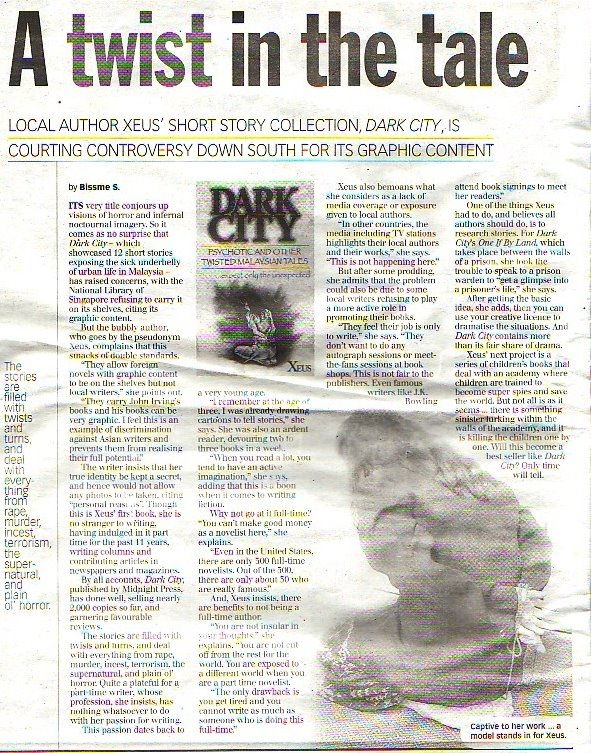
Call for Dark City 2 submissions in Star

And this is what appeared in the Star today.  So far I have got 3 confirmed stories I am taking - all 3 so far are from established famous writers. But it really doesn't matter. 

If you're a first time writer and you've got a twisty story to tell, do write in. Remember, this is one of the few anthologies that actually pays. Your twisty story can be from any genre - Trashcan Child itself would fall under the category of fantasy/science fiction. And if I think your story has promise, I will write back and ask you for edits.

But before you write in, read as many twisty short stories as you can and adhere to the rules of storytelling: Show, don't tell. Conversations must be in separate paragraphs. Build suspense until the very end. Always mystify the reader, don't reveal everything at one go. The ending must be a shocking punchline.

For twist in the tale kind of stories, I advise you to pen an outline beginning with the twist at the end, and then work backwards to start at the beginning.

More information in the sidebar.
 
http://thestar.com.my/lifestyle/story.asp?file=/2006/12/3/lifebookshelf/16124764&sec=lifebookshelf

Chill and thrill them

AUTHOR Xeus is calling for short story submissions for the sequel to Dark City: Psychotic and Other Twisted Malaysian Tales (Venton Publishing), scheduled to be published next April.

Each story should be between 3,000 and 8,000 words and must have a totally unexpected twist at the end. Writers of stories selected for publication will be paid RM150 and will receive four free copies of Dark City 2.


The closing date for submissions is Feb 28, 2007.


E-mail stories and enquiries to dark.city.xeus@gmail.com. For more information about Dark City, go to darkcity-xeus.blogspot.com.
 

Star serialisation Part 2

Trashcan Child - Part Two

http://thestar.com.my/lifestyle/story.asp?file=/2006/12/3/lifebookshelf/16124605&sec=lifebookshelf

Do we get second chances?


In the final part of the condensation of Trashcan Child from Dark City: Psychotic and Other Twisted Malaysian Tales, author Xeus reveals the shocking twist in her tale.


ANOTHER year passed uneventfully. Patience grew up, learnt to run, stumble and fall. She learnt how to count and read, and with that came a period of books, toys and demands. Ida bought picture books for Patience by the dozen. Each night, before the toddler went to bed, Ida would read her a story.

August thirteenth dawned hopeful. Once again, Ida dressed Patience in her best clothes and waited for Pearl to come.

But once again, as the day waned into sunset, no one showed up to claim the child.

♦♦♦♦♦♦♦

The ball whizzed through the open window and struck the Ming dynasty urn full force, shattering it to pieces.

“Oh!” Patience gasped. Her hands clapped over her mouth. Mama would be so mad. She loved her vases so and Patience had always been so careful not to lay a finger on them.

Almost not daring to look, Patience tiptoed into the house, where the precious urn lay in ruins at the back of the cabinet. Was there a way to glue the pretty blue and white porcelain pieces back? Was there a way to roll time back? And what was that grey dust scattered all round the shards and on the floor? Patience knelt to finger it. The Ming urn wasn’t empty after all. It was a vessel for what felt like –

“Patience! What have you done?”

Patience jumped back guiltily, cringing. “I didn’t mean to, Mama, please, I’ll pay you back.” At the back of her eyes, she felt hot tears begin to pool.

”Go to your room, child.”

That’s it? Patience peered from between her fingers. Her mother was kneeling, sifting through the grey ashes in her hand, the expression on her face pensive.

Her face was shrouded in such sadness that it struck Patience harder than any physical blow.

“I said go.” Her mother’s voice was flat, without affect.

Patience fled to her room.

Oh, but Mama was so good to her. And she was always disappointing Mama. She could see it in Mama’s eyes, as though she couldn’t quite measure up, no matter what she did.

The bedroom door creaked open. Wiping her eyes, Patience looked up. Her mother stood at the door, face wary.

“Oh, Patience.” Mama just stood there, as if afraid to come in. “The urn doesn’t matter. Really, it doesn’t.”

“But it does! I know how much you love it.”

Patience held out her arms, willing Mama to come to her. And Mama did. They hugged, and she knew all was forgiven. But as always, she could feel Mama holding back.

“What is it, Mama?” she whispered.

“Nothing. It’s your Special Day, that’s all.”

“Is it my birthday?”

“Sort of. Only better.”

“Why do I have a Special Day and not a birthday like the other kids?”

“I don’t know,” Mama said into her hair. “But one day, you and I will find out.”

♦♦♦♦♦♦♦

She was being followed.

Behind them, furtively ducking behind street corners and into shop entrances, hiding behind throngs of pedestrians, always keeping a good distance away, Patience could glimpse the woman with the haunted eyes. The eyes mesmerized her, even from this distance, and an odd sense of déjà vu wormed through some submerged memory. Where had she seen that woman before? And why were such strong emotions associated with the memory? In all her eight years of life, she had never felt this way.

“Mama.” She tugged at her mother’s hand. “There’s a stranger following us.”

“Where?”

“There. That one.”

Mama looked long and hard at the woman, who was now unsuccessfully trying to merge with a lamppost. The woman was dressed in a baggy T-shirt and faded jeans, ripped at the knees. She had a mouth like a splash of wet paint against pale, pale skin, and she looked as though she hadn’t eaten well in years.

“Do you know her, Mama?”

“No. But she’s only a girl,” Mama murmured.

“Who is she?”

“I have no idea.”

“Why is she following us?”

“I don’t know, but we should keep walking.”

Later that night, Patience awoke to low voices from the lounge downstairs. Mama was having a rare midnight visitor. Creeping silently to the top of the landing, Patience bunched up her knees and sat on the top stair, peeking through the banisters and cocking her ears to listen.

“... couldn’t keep her,” the stranger from today stood at the door, barred from entering by Mama. “I was a mess. I had no money, no prospects.”

“That’s no excuse. What you did was very, very cruel.” Mama’s voice was severe.

“I know,” the stranger replied miserably. “That’s why I’m here now. Like you.”

“Don’t compare yourself to me. We’re not alike.”

“I didn’t mean for any of it to happen. I was just a child.”

“You should go.”

“I just wanted to see her, to see how she’d turn out.”

“Well, you saw her.”

”Can I talk to her? Just to tell her how sorry I am?”

“I think it’s best you didn’t. And now, you really should go.”

♦♦♦♦♦♦♦

“I think I should take up nursing.”

Her mother looked up from the porcelain teacup she was sipping. “But why?”

“I want to help people.”

“I’d rather you be a doctor. You can help more people that way, and make a better living out of it.”

The sixteen-year-old Patience pursed her lips. They had had this conversation many times.

“Mama, I told you. I’m not interested in being a doctor. It’s not the only noble profession out there, okay?”

“It pays better.”

“But I’m not interested in money.”

“You think you’re not now, but –”

“Mama, I mean it. I’m really not interested in money.”

Patience looked so serious that Mama ruminated over this.

“No, I suppose not,” her mother said thoughtfully.

“I suppose none of it matters in the end.”

Patience sat down on the sofa next to her mother. “It’s not that bad, Mama. I’ll be helping a lot of people. You’ll be proud of me, you’ll see.” She laid a hand on Mama’s belly, where she knew the old scar lay, bunched up like an overgrown keloid gash.

“I’ll be able to help people who have cancer, just like you once had. You were lucky to be cured of it. But there are plenty of cancer victims out there with no one to support them, and I believe that’s where I can make a difference.”

♦♦♦♦♦♦♦

As the years tumbled into one another, Ida watched from the sidelines as Patience graduated from nursing school, scored As in her class, landed a posting in the General Hospital’s oncology ward, and become – in her superior’s words – the nurse “most likely to make a difference in people’s lives”.

Now Ida understood why it could be such a joy to have children, to watch them grow from rough-edged saplings to worthwhile people on their own. But I wouldn’t have just any child. It could only have been Patience. And indeed, Patience was the sweetest, most tractable daughter anyone could wish for. Ida had brought her up well. When asked the secret of her success, Ida would say, “It was easy. I didn’t impose my will on her. I simply let her be.”

The vague fondness she had felt for Patience in her formative years had now deepened into an unshakeable bond between mother and child. Why, Ida realised, tears in her eyes, this is love. I love that trashcan child more than her own poor junkie mother could ever claim to.

One day, Patience came home, breathlessly flushed with excitement. “Oh, Mama, he’s asked me to marry him!”

“Who? That nice doctor you’ve been dating?”

“The one and only!” Patience flung her arms happily around Ida. “Oh, I’m so happy!”

Ida hugged her back. She would be alone again, free to carry on with her life before Patience had come into it.

Suddenly, Ida couldn’t bear the thought of going back to it.

“I’ll come home every week, I promise,” Patience assured her.

Patience kept her promise to visit every week, and she brought along her new husband to brighten up Ida’s days. And then Patience got pregnant and gave birth to a daughter of her own, whom she named after Ida. Later on, a son was added to the ensemble. Both children were spunky, opinionated and individualistic.

Instead of losing Patience, Ida had gained an entire family.

And then one day, it came time for her to die.

Ida was eighty-five years old. The baby Patience had come to her when she was fifty and was now thirty-four, a beautiful mother in her prime. “I’ve done well by her,” Ida thought as she lay in her hospital bed. “I really have. I have no regrets this time.”

Now, the sun was rising outside. The door yawned open, and Ida looked up, expecting the morning nurse.

But it was a visitor she had not seen in thirty-five years.

A little too late, Ida realised it was August thirteenth. Pearl stood beside her bed, as unchanged as the day Ida first saw her.

“You’ve come for her,” Ida stated.

“Actually, no,” Pearl said, her eyes smiling. “I’ve come for you.”

“It’s time then.”

“It’s time.”

Ida laughed softly. “I never thought I’d get a second chance.”

“All of us get second chances. Even the ones who don’t think they need one.”

“So have I – passed?”

“It’s not a test, Ida.” Pearl sat gently on the bed and took Ida’s hand. “How do you feel this time round?”

“Dying a second time is never easy. The first, so many years ago –” Ida shook her head “– the cancer ate at me. I was riddled with it. I asked to be cremated then because I wanted to burn it out.”

“But you kept the scar, to remind you.”

“I kept the scar,” Ida agreed. “Will she ... live on?”

“Until she’s ready to go, yes.”

Ida looked around her. “This place you guys have created. You can tell your boss it isn’t half-bad. Could do with better Darjeeling though.”

Pearl smiled. “Tell her yourself,” she said, closing Ida’s eyes one final time.

♦♦♦♦♦♦♦

“Oh, my goodness me. You poor baby. Who could’ve put you in a trashcan?”

Pearl lifted up the dead baby, letting the soaked blanket fall from it back onto the garbage bags.

Someone had drowned the poor little thing and cast it aside like yesterday’s trash.

“Don’t worry, little one,” she crooned as it opened its hidden eyes to smile up at her. “We’ll find you a home yet. You’ll get your second chance.”



 

Friday, December 01, 2006

New blog look and call from Thailand


How do you like the new blog look? I spent 3 hours shuffling things around and it still looks a little
off! 

Anyhow, I got this call from an American guy called Geoff, who runs a website at http://www.thaioasis.com/literature/bkkbangkokfiction.php . This one previews all the Thai books. He wants to review Dark City for the Malaysian part of this website for expats and visitors to our neck of woods.

He really loved Dark City, especially Scarlet Woman and The Maid, and he asked me, "How did you get into the mind of such low-lifes?" To which I replied something like, "Uh...it takes a low-life to know another low-life, so it was kinda easy writing about them."

Anyway, look out for Yvonne Lee and her new Malay translation of 'A Sky is Crazy.' Sure to skyrocket to the Malay bestseller charts soon, and I can tell ya, Malay books sell by the hundred thousands.

Saturday, November 25, 2006

Star serialisation - Trashcan Child

Ah, here finally comes the first part of one of Dark City's Star serialisations. I had a hard time choosing 'sanitary' stories for newspaper publishing, I can tell you:)

http://thestar.com.my/lifestyle/story.asp?file=/2006/11/26/lifebookshelf/16124577&sec=lifebookshelf


Trashcan Child

When a woman who doesn’t want to be a mother is given a baby nobody wants, things can take a macabre turn. This is the first of a two-part condensation of Trashcan Child, one of the stories in Dark City: Psychotic and Other Twisted Malaysian Tales, by Xeus.


AS the most splendid sunrise ignited the universe, lighting treetops and their slumbering winged tenants into an explosion of birdsong and morning, the baby awoke.

The first thing she did was to stretch herself, bunching up her fists to strike at surrounding objects; her little hand encountered a soggy wetness, a mushiness alien to anything she’d ever felt before, and she withdrew it sharply.

With the smells came a more familiar sensation, the belaboured effort to breathe, to fill her lungs with deep, pungent air and her starved brain with oxygenated clarity. Her little chest rose up and down rapidly as it worked itself up, sparking little black and gold stars in her vision as a wave of dizziness swept across her. Yesterday was a struggle too, when she had been half-submerged in that sticky fluid; she had inhaled it, and the insides of her windpipes had been seared with a sudden agony. Through her watery prison, a woman’s shadowed face rippled, with hooded eyes, quivering mouth in a semblance of weeping. The baby had smiled up at that face, held up her arms to be embraced (but couldn’t, because they were pinioned), and so she opened her mouth ‘O’ style to eke out a like-shaped bubble, which rose lazily to dissipate at the surface.

The baby waited, and she wasn’t disappointed. Along came the crunch of footsteps on gravel. A shadow fell across the edge of her bed, and a face peered down, framed by blue sky. Pretty smiling eyes accompanied by dimpled cheeks.

“Oh, my goodness me. You poor baby. Who could’ve put you in a trashcan?”

The words were unintelligible to the baby, but she smiled anyway, sensing rescue and possibly a whole new world than that which she had been born into. . And indeed, firm hands clasped her shaking body and lifted her up, holding her close. Warm, warm flesh and the soft smell of flowers.

******************

From her paned windows upstairs, Ida could see the woman approaching, bundle in her arms.

But I don’t want this.

It’ll be good for you. To have someone to care for other than yourself.

Can’t you find someone else? Someone more ... appropriate? Someone who actually likes children?

Ida. We’ve talked about this.

The doorbell rang, a booming chime in the blessed stillness of the house. I still don’t want this, Ida thought as she made her dignified way downstairs, past a child’s bedroom with a freshly painted cot (her old baby cot, kept by her late mother in the hope that she would have a baby of her own some day). Carefully chosen landscape paintings hugged the walls of the hallway and landing, alongside carefully displayed vases, crystal and a potpourri of fragile collectibles.

Of particular reverence, at least in terms of holding centre court, was a beautiful Ming Dynasty urn in the living room display cabinet. This was surrounded by lush Italian furniture, embroidered in red and gold thread, upon which were now draped objects unfamiliar to the house: a new child’s blanket, several diaper bags and a hamper of baby clothes.

Through the frosted glass panels of her oak door, Ida could see the geometrically distorted head of Pearl. She opened it.

On the terraced steps leading up to the door, alarmed by the sudden intrusion, the baby in Pearl’s arms began to cry. Ida’s mouth immediately flattened into a firm, thin line.

“Oh, come now, Ida, don’t look like that. You were a baby once. I’ll bet you cried too,” Pearl admonished.

“I’ve never liked babies. I told you that. Never liked children or teenagers either. Can’t abide the noise and the fuss. Always crying. Always demanding something.”

“Not all children are like that. It’s how you bring them up.”

Pearl handed her the baby. “Here. Hold her like this. That’s right. Support her neck like this. She can’t hold up her head yet.”

Ida clasped the crying baby to her chest, grimacing as she tried to get a comfortable fit. How did one hold a crying baby?

Were you supposed to coo or ignore them till the noise went away? The baby felt alien in her arms, like a guilty burden that weighed too heavy for its own good.

“How do I get it to shush?”

“Now, Ida, it’s a ‘she’, not an ‘it’. Talk to her a little. Hold her close to your bosom. She’ll calm down after she gets used to you.”

The baby wailed louder. Ida held it away from her body in distaste. “Here. You take her back. You’re better with babies.”

“No, I won’t.” Pearl back-stepped lightly. “You’re going to have to get used to this all by yourself.”

“But I don’t know anything about babies!”

“You have the books. You have everything you need. Like any other new mother, you’re just going to have to experience it for yourself.”

“I’ve never wanted to be a mother,” mumbled Ida beneath her breath. “I’m too old.”

“I’ll come back on August thirteenth, at half past seven am.”

August thirteenth! Almost a whole year away. “But I can’t look after her all this while. She’ll need a proper home.”

But Pearl had already turned tail. She was walking abruptly down the drive.

“Wait! What shall I call it ... I mean her? What’s her name?”

“She doesn’t have a name! You’ll have to find her one. And remember, I won’t be in contact till August thirteenth!”

“But what if I need to call you or ask you something about the baby? How will I get in touch?”

“You won’t need to.”

And with that, Pearl disappeared, leaving Ida all alone with the baby.

******************

The sound of crying once again wafted from the baby’s room at the other end of the corridor. Every night for the past two weeks, the infant had woken up at two-hourly intervals, as though she was a clockwork doll designed to torment.

Why couldn’t the cursed child stay asleep? Surely she couldn’t be hungry again?

As she wearily got up, Ida reflected on the reasons why she had remained childless. The Australians had a term for this: she was not “clucky”. She had no desire to be a mother hen, and if she had a biological clock, it was in need of greasing. But it was precisely this: the nighttime terrors, the profound weariness which she suspects will worsen as the months take their toll, and the sense the rewards would not commensurate with the effort put in. She had always seen babies as a chore, an extra mouth to feed (and at ungodly hours), a little wriggling bundle to zap her away from her precious interests: like collecting antiques, reading and sipping tea on the terrace, going to the spa and having a facial.

Indeed, for the past two weeks, she had neither the time nor the energy to do the things she liked. The book she was reading, Paulo Coelho’s latest, remained dog-eared at the very spot she’d left it when she had been waiting for Pearl and the child.

In the cot, the baby’s face was puckered a furious red. As Ida forced the bottle into her open mouth, she began to suck lustily. It was still “she”, Ida had not progressed to naming her yet. She finished the entire two ounces, spat out the teat and burped on her own accord. Then she promptly fell asleep on Ida’s shoulder, drool spooling down her guardian’s silk pyjamas.

Drat. If I put her down on the cot, she might wake up and start crying again. Ida couldn’t bear the sound of crying; it grated on her nerves, like squeals on a chalkboard. And yet, she retained a sense of responsibility to the child. It came from long-standing penitence; she would never be an intemperate caregiver, like so many guardians are wont to be.

Brain numbed from accumulated fatigue and half-conscious of what she was doing, Ida shuffled back to her own bedroom, baby still slung like a sack of potatoes across her shoulder. She crept into her rumpled bed and lay down flat, the baby still tucked into the angle of her back and shoulder. Before she knew it, she had awoken. The sun was streaming through the windows and it was high morning.

The baby had slept for a good six hours.

The next night, Ida dragged the cot into her bedroom. But the baby never slept as well as when she was next to Ida in bed. Just the nearness of Ida alone seemed to calm the child down, so that she slept through the night.

At the end of the month, Ida named the baby Patience, for their shared experience of that certain virtue.

******************

The year passed uneventfully. Patience learnt to crawl, walk and say “Mama”. Ida marvelled at each milestone even as the baby doubled in weight and size.

“Don’t call me Mama. I’m not your Mama. And this is only temporary, lest you get too comfortable.”

“Mama,” insisted Patience.

“On your Special Day, you’ll have a new Mama.”

August thirteenth became the Special Day, the eagerly awaited hour when Ida would gain her redemption and Patience would be carted away to a better home. Ida was not sorry Patience was leaving. It was time for a new beginning. There had been satisfying moments, like when Patience took her first step and said her first word. But Ida was not mother material; she retained no firm attachments to the child other than a vague fondness, like that of a nanny or governess. She felt no kinship. Perhaps what the old wives said was true: one could not love a child unless the same blood flowed in their veins.

But still, there were moments of bliss. Like the pure unadulterated look of joy on Patience’s face each morning when she cried “Mama”. Of being the centre of the child’s (someone’s) universe.

On August thirteenth, the two of them woke up early. Ida dressed Patience in her best baby frock, the one with the pretty blue bows, and topped it off with the cutest white bonnet.

“Someone will be coming for you. You’ll have a new home, and new clothes.”

“Mama,” Patience said, holding out her arms to Ida.

Maybe I’ll kind of miss the little tot, Ida mused. But it was time to move on. Thinking of tomorrow, she was almost filled with dread. But there’s nothing to worry about. You’ve earned it.

Half past seven came and went like a bee cruising through their home. As Ida and Patience waited, the sun rose high, evaporated the dew and wilted the flowers, and still no one came. At midday, they ate sandwiches and mashed peas on the terrace. At twilight, as the shadows grew long and the sky turned to dusk, Ida took off Patience’s bonnet.

“Home,” Patience said.

“That’s right, we’re going inside.” Time for bed. “Maybe they’ll come for you tomorrow.”

“Mama,” Patience retorted, and grabbed fistfuls of Ida’s hair as she was carried inside the house.

Part Two of ‘Trashcan Child’ next week.

Friday, November 17, 2006

It's never too young to start writing (and self publishing)


Or perhaps I should title this post '15 year old self-published author makes it big.'

Behold the story of Christopher Paolini at http://www.alagaesia.com/ . You all might have seen the movie posters and trailers for 'Eragon,' the latest fantasy movie to come from a children's book. Everyone knows that once you've got your book made into a movie, you've really hit it big time.

Now, young home-schooled Christopher (what is it about these home-schooled kids that make them geniuses?) began writing Eragon when he was 15. It took him 1 year to write the 1st draft, and another year to revise it. His family then decided to self-publish the book. A 3rd year was spent with editing, typesetting and designing.

And then the whole family spent another year promoting the book themselves. Beginning with talks at the local library and high school, they traveled across the U.S. Then Christopher's hard work paid off. The stepson of author Carl Hiaasen read the book and brought Eragon to the attention of his publisher, Alfred A. Knopf. It was then traditionally published and there are currently 1 million copies in print.

Naturally, the movie script followed.

So learnings from this:

1. It's never too young to start
2. Even if it was initially tough, you might hit it big one day
3. Self publishing is not a tabboo. Just keep at it.

Speaking of which, I've got 3 stories already for Dark City 2, including one from the eminent Tunku Halim and two others from good writer friends. Keep them coming in :)

Thursday, November 09, 2006

If you had to write a Malaysian story....

...what would it be?

There are more Malaysian writers writing about circa WW2 than there are law-
breaking Klang assemblymen. But for me, WW2 is a pretty pedestrian subject. 

Okay, I suppose if it's written well, it's a good read.

BUT why don't Malaysians write about:

1. A parallel Malaysia where the 3 races are actually at war - contemporary setting. When the story opens, we have a protagonist who is a freedom fighter.
2. Historical fiction chronicaling the life of a street prostitute set in the era 
of the Portuguese 
occupation
3.  Hang Li Po - the true story of a princess who was sold into bondage 
(well, kind of)
4. 'Misunderstood' - the real story of Hang Jebat, who was branded as all-time villain wrongly.
(In this version, Hang Tuah is the actual villain)
5. The Fantastic 'Boleh' Four - 4 teenagers from Assunta Secondary School find they actually have superpowers
6. Lady Aminah's Lover - set in WW1 (ah, there's a difference finally), this is a Malaysian version of Lady Chatterly's Lover

Any suggestions? (Hey, this is fun!) The thing is - who's going to write it?
 

Saturday, October 28, 2006

David Gemmell is dead!


http://www.timesonline.co.uk/article/0,,60-2293450,00.html

I read this and was completely shocked! For those who're unfamiliar with David Gemmell's work, he's a fantasy writer. His works I enjoyed the most are the 'Lion of Macedon' series (about Parmenion, Alexander the Great's general) and 'Troy' (on Aeneas and Andromache).

What I admire about his works are his incredibly vivid action scenes. When you read them, they're utterly page turning and unputdownable, almost as though a movie was being screened in front of your eyes.

I learnt this from him:

1. Legends are good story fodder. Alexander the Great and Troy are eternal stories. But in writing them, give them a fresh angle by focusing on a lesser known character like Parmenion or Aeneas instead of the usual Alexander and Achilles/Hector types.

2. Make your villains as tortured and complicated as possible. Make them capable of good.

3. Obstacles and supporting characters with hidden motives must be strewn at every path. Make it really difficult for the hero! Make them face turmoil at every opportunity! (Parmenion, King Philipp's best friend, actually fathered Alexander the Great because Philipp was too drunk to do the deed on the wedding night). (Aeneas falls in love with Andromache, a lesbian, who is betrothed to marry his favorite cousin, Hector.)

I will sorely miss him.

Thursday, October 26, 2006

Is non fiction tougher to write than fiction?


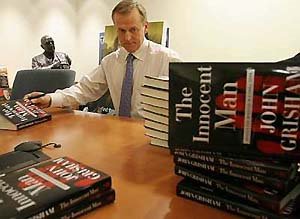
John Grisham has this to say.

"BESTSELLING author John Grisham has turned to non-fiction for the first time, and, surprised by the amount of time and energy it took, he believes it may well be the last.

The Innocent Man is the real-life story of of Ron Williamson and his friend Dennis Fritz, who were charged with the 1982 murder of a cocktail waitress.

Williamson, who was mentally unstable, was convicted and sent to death row in the United States, where he came within five days of being executed for a murder he did not commit. He and Fritz were eventually freed after DNA tests showed there was no link between the men and the crime.

John Grisham signing copies of his first non-fiction book, The Innocent Man, in New York recently.

“This was too much hard work,” Grisham said. ”Non-fiction requires endless research, fact-checking, accuracy – things I’m not know for,” he told an audience at the annual literature festival in Cheltenham, England, recently. “This book probably took five times the effort that a novel takes. I don’t want to do it again.”

Grisham was drawn to the story when he read Williamson’s obituary in the New York Times in 2004. The miscarriage of justice against Williamson, who shouted angrily at witnesses during his trial after he had been denied psychiatric medicine for months, reinforced Grisham’s doubts about the US legal system.

“It didn’t change my opinion of the death penalty because I’ve been opposed to it for a long time,” he said. “It goes back to the issue of a fair trial. If you can’t give people a fair trial, then your system is broken.”

The book is also an attack on what Grisham saw as sloppy police work in the small town of Ada, Oklahoma, and its impact on an innocent man. “He (Williamson) went insane on death row and came within five days of being executed, and when finally he was exonerated he drank himself to death.”

Grisham, one of the world’s most successful writers with global sales of more than 200 million books, recalled his humble beginnings as a lawyer and novelist. The print run on his first book, A Time to Kill, was a modest 5,000, and its lack of success nearly put him off writing for good.

“I bought 1,000 (copies), and I sold the copies from the trunk of my car,” he said. After the failure of A Time to Kill, Grisham decided to have one more try with The Firm, which he made “as blatantly commercial” as he could. The Firm turned into a movie starring Tom Cruise, flew off the shelves and established Grisham as a literary star. He has written 18 novels in total, many of which have been turned into feature films. – Reuters


Anyway, I have always found fiction more difficult to write than non-fiction. Maybe it's because I don't research that much! And I've learnt something else from John Grisham - just because your first book isn't a success, it doesn't mean your second book won't be. (And when you become a success, your first book will sell too.) And in order to sell a lot of books, you have to make your stories as 'blatantly commercial' as possible. I wonder what he meant by that.

Saturday, October 21, 2006

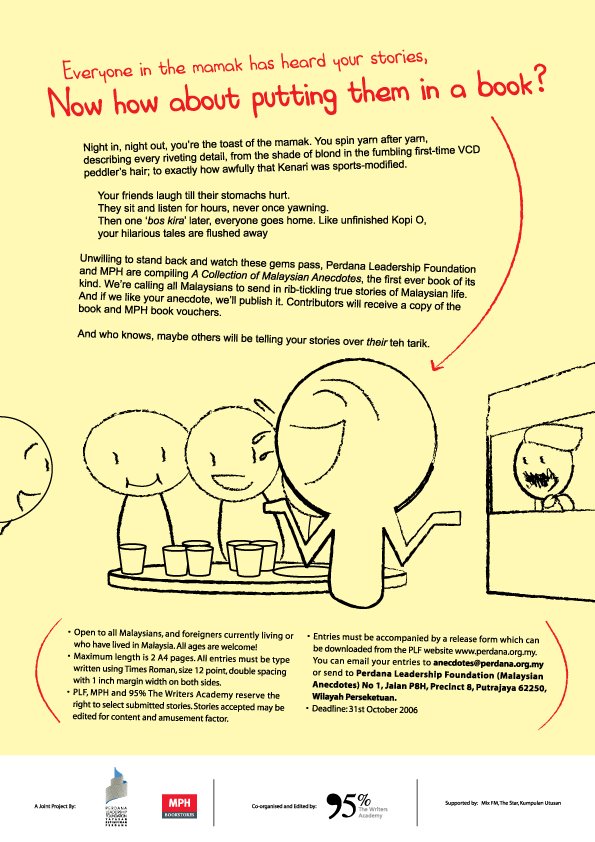
Book on Malaysian anecdotes - collecting submissions


At least they're going to pay you with 1 free book and some MPH vouchers! Closing date is Oct 30th.

On another note, my agent came back from the Frankfurt book fair. And he says:

1. He's collected a lot of publisher contacts, and many are interested in Billy Lang. BUT they want to see the finished manuscript naturally. I asked if it was possible to shoot for the moon (to quote Cecelia Ahern in PS, I love you) and talk to Harper Collins. He said it's always possible.

2. Note that these things take a long time to get. Months. Sometimes years. So an interested party doesn't always mean it will work out.

3. He's even got a few interesting in republishing Dark City for the UK market. Including the one that did Shanghai Baby because they're interested in Asian works. We'll see what comes out of that!

Meanwhile, he says there's a Singaporean publisher really interested in collecting Malaysian Ghost stories, and he asked me to write it. I said, "Are you kidding? I'm writing Billy Lang AND collecting for Dark City 2. Whad'ya think I am? An octopus with 8 arms and 4 writing brains?"

So if anyone's interested to get published, you know what the Singaporean market craves for.

Ah! Importantly, I might have my first story already for Dark City 2. I won't reveal the contributor yet but I really liked the plot and was quite pleasantly surprised/shocked at the ending. I asked the contributor to rework the story to make it longer and more suspenseful.

And the rest of you fellow writers, bring your contributions on!

Wednesday, October 18, 2006

When the story writes itself

Ever began writing something with a fixed plan in mind, e.g: By Chapter 7, protagonist should be getting to Place A, or by Chapter 16, the war begins etc, only to have your story carried away by the characters themselves?

I was reading Sharon's interview with Anita Desai. And even those Booker Prize winners/nominees don't know who the murderer is until the end of the book! Stephen King also espouses this method. "Which is more fun?" he says. "Going along for the ride with the characters, not knowing what will happen next? Or planning every step of the way?"

I have to agree with Stephen. It's a lot more fun going for the journey without knowing what happens next. This is exactly what I'm experiencing now while writing Billy Lang, my children's book. I'm up to Chapter 9 now, and I have 10 extra chapters in the bag of what will happen to Billy later once he gets past this hurdle. And I'm finding that Billy is writing himself. (Or the hurdle keeps on getting more complicated all on its own.)

For example:

1. I had initially planned for Billy to be kidnapped by the boy with red eyes in Chapter 4 and whisked off immediately into the Demon Realm, whereupon they will go on a demon train ride through terrains never seen before by man.

BUT

Billy is kidnapped, but seized from his captors instead by a magician with the souls of dead children for his familiars. He is now imprisoned in the House with No Windows and is planning an ingenious escape or he would be certain to face an awful death. Naturally, obstacles conspire that this escape won't be easy.

Things just happen to the guy (out of no volition of my own) and he keeps finding ways to stay one step ahead! It's like I'm thinking, "What would he do in this situation?" Or, "What would this villain do in this situation?" Or, "What would this secondary character do in this situation to complicate matters? They're not going to be innocent bystanders, are they?" And they all end up as real people trying to outwit one another.

Maybe it's like what John Irving says, "I just think of the characters, and they write themselves."

(Bangs head on the wall.)

Anyway, at least I'm having fun with a protagonist who came completely to life all on his own.

Saturday, October 14, 2006

Sun interview


I'm really slow with this, I know. It was published over a month ago.

Wednesday, October 11, 2006

Dark City 2 - calling for submissions


Ok guys, it's a go. Please do contribute if you want to and do spread the word around. Remember, this will be one of the very few anthologies which actually pays!


Dark City 2

For the Dark City sequel, which is scheduled to be published in April 2007, author Xeus is calling for short story submissions. Dark City 2 will be an anthology of dark and twisted Malaysian tales much in the tone of the first book.

The submission criteria are:
1) Each short story should contain around 3000 - 8,000 words. Please use double spacing and Microsoft Word.
2) Each plot must be in the same vein as Dark City 1, which are stories about the darker side of Malaysian life. The short story genres can be contemporary, horror, fantasy, science fiction, suspense, romance, Roald Dahl-style ironic etc.
3) The stories must meet the English and storytelling standards of the first book. (In other words, the editor will only select only what is publishable)
4) Each short story must contain a twist which hopefully no reader will see coming
5) This is open to published and unpublished writers of all ages. For unpublished writers, this allows you an opportunity to be published and to use this in your literary resume. You will then be able to sell your work more easily to a future publisher.

Your story will be selected on the strength of its plot, your ability to beguile the reader, and the shock impact of your twist. Your story must be concise, gripping and satisfying! Selected contributors will be paid RM 150 and 4 free books for each story. You can submit as many stories as you like.

The editor reserves the right to conceptually edit selected stories in the purpose of making them more appealing and ask you for a rewrite.

Closing date is Feb 28th, 2007. Good and publishable stories will be selected on a first come, first serve basis. So if you’re interested, get cracking now!

Stories are to be submitted to dark.city.xeus@gmail.com

For more information about Dark City, log on to www.darkcity-xeus@blogspot.com/

Monday, October 09, 2006

Dark City - the sequel

Ah, apparently the National Library of Malaysia wants to order 500 copies of Dark City to distribute nationwide in all the library branches. I wonder if they know what they're buying :) Such a contrast to the Singaporean National Library, yes?

If this sale goes through, I would have sold almost all of the 3000 first print run already. (That is, if the bookstores don't return them at the end of the year!)

On another note, my Malay translation is taking a long, long time. Apparently, the guy has translated only 3 chapters!! My publisher says he will find another guy if this one doesn't complete it on time. Does translation actually take that long? (Okay, maybe if I did it, it will.) I = saya. He = dia.

Anyway, my publisher and I agreed on some things already. We want to do a sequel, and since I'm writing Billy Lang, there is one way to get a sequel out easily. That's right, I'm calling for submissions.

But before I go to the press with it, I need your opinions.

1. Since I believe in paying for submissions (unlike some anthologies), would RM 150 + 4 free books to each contributor cut it? (Note I'm taking this money out myself, and we're never ever sure what we're going to earn per book. And other people who collect anthologies don't even pay.)

2. My criteria are:
a) Up to 12,000 words per story
b) Must be in the same vein as the stories in Dark City 1 - meaning stories about the darker side of Malaysian life. And it must meet the English and storytelling standards. (In other words, I will only select what is publishable)
c) Each story must contain a twist that hopefully no reader will see coming
d) This is open to published and unpublished writers of all ages. For unpublished writers, this allows you an opportunity to say you've been published somewhere, and to sell your future work easier to a publisher.

Does this sound feasible to you?

And on yes, please do spread the word so that people can contribute. I will select the stories, of course.

Thursday, October 05, 2006

Readers' writes and Yvonne Foong's book


Do you, now and then, Google yourself?

I must confess I do it once a week. Since I have 4 or 5 pen names, I Google them every now so often. I also Google my real name to see what pops up. But the words that I Google most are "Dark City, Xeus." (I know, I know, I'm very pathetic.)

Anyway, I Google myself just to find snippets like these on other blogs. This one absolutely made my day.

http://thehaberdashery.wordpress.com/

"I noticed local author Xeus’s Dark City on the shelves, found an open copy, read the first page and couldn’t put the book down until the whole tale was finished. Xeus’s writing is elegantly understated, her dialogue noirish and she does clever flashback cuts to increase the suspense. This former fan of twisted, violent tales was impressed. It’s another book to add to the shelves next visit."

Was at MPH 1 Utama the other day and found Yvonne Foong's book 'I'm not sick, just a bit unwell' featured prominently at the bookshelf end in the Malaysiana section. It was rapidly depleted too! Please do support her. Congrats, Yvonne, for getting it distributed so well.

Friday, September 29, 2006

Reply from UK publisher....and how to write humor

How exciting! I actually got my first reply from a UK publisher for my children's book, Billy Lang. It's far from being an affirmative, but at least they are willing to look at it.

I think you must think me lame, but this is very exciting for me!

"Thanks for this. We are looking at the programme for next year but not
including much children's fiction unless it fits well with other titles we
are planning. Anyway we will take a look and get back to you.

All the best."

On another note, I want to thank MPH MidValley for giving me a wonderful poster display, which absolutely works because the books began moving as soon as it was up. They are so kind!

I'm currently reading the 'banned book' The Marriage Market, by Nisha Minhas, which is absolutely hilarious, her funniest book yet. This one is about a British born Indian girl marrying a white man and being disowned by her family. It's a laugh a minute romp about a very serious subject.

Excerpt:
"With a hangover so severe that Aaron had to threaten his nine goldfish with his George Foreman Lean Mean Fat Reducing Grilling Machine for making too much gill noise, he arrived..."

Which brings me to: how you write humor?
I have been writing humor for ages in my That's Just Suzie column, alongside other articles.
And if there're several things I'm certain about:

1. You've got to be Over The Top (OTT) with your descriptions
2. Hit your readers with totally unexpected sentences
3. Your situations and dialogue have to be OTT
4. Mishaps are funny. People like reading about bad things that happen to other people, which are written in a funny manner.

What else do you think makes a book funny?

Saturday, September 23, 2006

My first reading

I have never been to a reading before, and so I always had this impression we must not read for too long (just enough to give everyone a flavour of what you write) or everyone will get bored!

So I arrived for the Bangsar reading really, really late. There were flash floods and hailstones around the Bangsar area, and for a moment, I expected to see frogs raining down too (it can happen), all because it was my first reading and the powers that be are conspiring to keep me from it. But I was not be deterred and I arrived 1 hour late.

(I also wished I had driven my Harrier instead of my very low Cellica, then I would have gone through the flash floods in a twinkle of an eye.)

I arrived when Joy (I don't know her, I got her name from Ted's blog) was reading a part of her script. Ted was there too (hi Ted!) and I met Aneeta. Sharon was busy coordinating everything, what a dear. Then Faridah read one ofher poems from The Art of Naming, about being a Muslim woman behind the veil, and I thought it was pretty poignant.

Then it was my turn! Sharon introduced me, and when she told everyone my book had been banned by the Singaporean National Library, everyone laughed. I read the first part of One if By Land (thanks Argus). After that, Aneeta read the shortest story from Snapshots (I can verify it was really short), and then it was all over because Jit Murad couldn't make it.

I had fun. So if you have a reading, you can invite me anytime. And maybe next time, like Yvonne, I will get a few friends to enact a scene. (PG rated, of course!)